
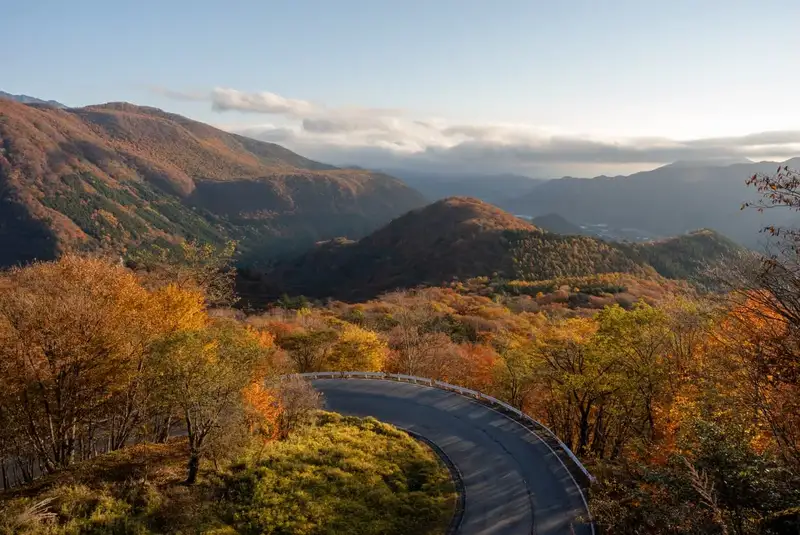

On foliage-season Saturdays and Sundays the Irohazaka jams from 9:00 to 15:00, sometimes until 17:00, and a climb that normally takes about 20 minutes can take 3 hours. The blunt truth about Nikko autumn is that how much you care about crowds determines what foliage you actually see. This guide is for travelers who want the Irohazaka 48-curve panorama, Lake Chuzenji's caldera autumn, and Kegon Falls thundering through cool air — and it spells out the timing (on the hill before 7:00 a.m. on weekends), what to shoot while the Akechidaira Ropeway is closed, the 3-day Tokyo round-trip itinerary, and the Pass math that actually saves money.
📍 For the full 5-region Japan koyo timing map, see Japan Autumn Foliage 2026. This article is the Kanto + Chubu deep-dive on Nikko within that framework.
Why Nikko is Tokyo's best autumn day trip

Three things Nikko has that other Tokyo-area koyo spots don't:
- Closest high-mountain foliage from Tokyo. Asakusa to Tobu-Nikko is 1h50 on the Spacia X, then a 50-minute bus to Lake Chuzenji at 1,269m. Half a day gets you onto a 1,000m+ alpine plateau.
- Compressed geography. Foliage, waterfalls, a caldera lake, hot springs, and a UNESCO shrine complex are all inside a 30-kilometer radius. Few Japanese koyo destinations match that density.
- The shrine bonus. Toshogu (the Tokugawa mausoleum and UNESCO site) under late-November maples is a cultural overlay you simply can't get at Arashiyama or Kawaguchiko.
The downside is just as clear: peak-week weekend traffic on the Irohazaka is genuinely brutal. About 80% of this guide is about how to avoid that.
Irohazaka: the 48 switchbacks & how to beat the gridlock
Irohazaka is the mountain road from Nikko town (600m) up to Lake Chuzenji (1,269m). It splits into two one-way roads:
- First Irohazaka: downhill only
- Second Irohazaka: uphill only
The 48 curves across the two roads are each labeled with a syllable of the old Japanese "iroha" poem — that's where the name comes from. Photographically, the second Irohazaka has the more striking switchback views; the first is best appreciated coming down.
Three ways to beat the gridlock
| Tactic | How to execute | Difficulty |
|---|---|---|
| Weekends and holidays: up before 7:00 | The Nikko tourism association says the Irohazaka moves fairly smoothly "before 7 in the early morning"; Tochigi Prefecture's poster stretches that to around 8:00. I would plan on 7:00 and sleep in Nikko town the night before — the limited express from Asakusa alone takes 1h50, so a same-day start from Tokyo will not make it; if you are going up by bus, check the first Tobu Bus departure, since this window mostly works for drivers | ★★ (early wake) |
| Weekdays: up after 15:00 | This advice is for weekdays only. On Saturdays and Sundays the jam can last until 17:00, and an afternoon climb lands in the worst hour, 14:00–15:00 | ★ (lower light) |
| Pick a Tuesday, Wednesday or Thursday | The days Tochigi Prefecture recommends. At the height of the colour weekdays jam too, so still go early or after 15:00 | ★ (needs a day off) |
The jam window is 9:00–15:00, and on foliage-season weekends it can run until 17:00. Up and down normally take about 20 minutes each; in peak season either can take 3 hours, and 14:00–15:00 is the worst. Before you go, check the Nikko tourism association's congestion forecast calendar, which grades each day — its top grade means 120 minutes or more from the station to Lake Chuzenji.
New for 2026: no right turn at Futara Bridge, and temporary parking
On Saturday, October 31 and Sunday, November 1, from 8:00 to 15:00, right turns are banned at the Futara Bridge junction in Chugushi. It is a trial Tochigi Prefecture added this year, and it is cancelled in bad weather. The Kegon Falls car parks sit inside that zone, so if you drive up on those two days, follow the traffic marshals rather than your sat-nav.
Temporary car parks open on seven days this year: Oct 31, Nov 1, Nov 3, Nov 7, Nov 8, Nov 14 and Nov 15. The latest notices on both are on the Nikko traffic information site (Japanese).
Akechidaira Ropeway: the four-in-one composition (currently closed)
⚠️ 2026 service notice: Akechidaira Ropeway is closed for maintenance.
Per the operator (nikko-kotsu.co.jp/ropeway/) and the KKday product page, the ropeway is closed for renovation from January 16, 2026 to August 31, 2027, with reopening planned for September 2027. The observation deck is unreachable for both the 2026 and 2027 autumn seasons. The section below stays as reference for when service resumes; alternative viewpoints are listed at the end.
Akechidaira sits at the top of the second Irohazaka, right at the lip of the Lake Chuzenji basin. When the ropeway reopens, from the parking-lot ropeway station, a 3-minute cable car (¥1,000 round trip pre-closure) climbs to a viewing platform where four signature elements line up in a single frame:
- Kegon Falls (97m drop, viewed from above — the only spot that gives you the falls-and-foliage combination)
- Lake Chuzenji (a caldera lake; from elevation the surface looks deeper, almost black)
- Mount Nantai (2,486m, Nikko's sacred Shugendo peak)
- The Irohazaka curves (the only angle that captures the switchback geometry against red and gold)
Stack those four elements and it becomes the boss-level composition of Nikko autumn photography — one shot beats ten from any other vantage. (When it reopens: the platform holds about 30 people, so after 10:00 the queue runs 30–60 minutes. Aim for the 8:30–9:30 window.)
Alternatives while the ropeway is closed
None of these match the full four-in-one frame, but each captures a different piece of what Akechidaira gave you:
- Kegon Falls upper observation platform (free): straight-on view of the 97m drop. Doesn't need the elevator and costs nothing — your best zero-friction substitute.
- Kegon Falls base elevator (¥600 round-trip — the official fare is round-trip only; ¥400 for elementary schoolers, free below that): close-up power and spray, pairs naturally with the free upper platform.
- Hangetsuyama Observatory above Lake Chuzenji: the strongest "alternative composition" — gets you the lake + Mt. Nantai axis from elevation without needing the ropeway. Drive or take the bus from Chuzenji Onsen.
- Kurokami-daira observation point: small dedicated pull-off mid-way up the second Irohazaka, gives you the S-curve geometry against foliage even without the ropeway view.
Lake Chuzenji + Kegon Falls

Late October — all three private forecasters agree on that for 2026. For Irohazaka their start dates sit within three days of each other: Japan Meteorological Corporation Oct 20, the Japan Weather Association (tenki.jp, which lists Irohazaka only) Oct 21, WeatherNews Oct 23. For Lake Chuzenji the two are 10 days apart: Japan Meteorological Corporation from Oct 17, WeatherNews from Oct 27. The Nikko tourism association gives Lake Chuzenji, Kegon Falls and Irohazaka a range of mid-October to early November. The WeatherNews column below is the round published on Oct 8; its per-spot dates do get revised, so check again two weeks out. As of Oct 11, Ryuzu Falls has just entered peak with about 30% colour around the plunge pool, and Lake Yunoko and Yu Falls are starting to turn.
| Spot | WeatherNews: peak starts → leaf drop starts | Japan Meteorological Corp.: peak period |
|---|---|---|
| Oku-Nikko, Lake Yunoko shore | Oct 15 → Oct 27 | Oct 9–21 |
| Ryuzu Falls | Oct 15 → Oct 29 | Oct 7–21 |
| Lake Chuzenji | Oct 27 → Nov 10 | Oct 17–31 (best around Oct 23) |
| Kegon Falls | Oct 27 → Nov 9 | Oct 20 – Nov 2 (best around Oct 25) |
| Irohazaka | Oct 23 → Nov 8 | |
| Nikko shrines & temples (Toshogu, Futarasan, Rinnoji) | Nov 12 → Nov 25 | Nov 2–16 |
That table sets your route order: start high at Lake Yunoko and Ryuzu Falls, work down through Chuzenji and Irohazaka, and leave Toshogu down in town for last. To catch Irohazaka and Lake Chuzenji in colour on the same trip, aim for the last week of October. If I could only commit two days, I would take Wednesday, October 28 and Thursday, October 29: both forecasters have Lake Chuzenji, Kegon Falls and Irohazaka at peak, and they are weekdays. The October 31 – November 1 weekend has Irohazaka and Kegon Falls at peak in both forecasts, while Japan Meteorological Corporation's Lake Chuzenji window ends on Oct 31, and those are also the two days of the right-turn ban and temporary parking — if you go then, be on the hill before 7:00.
Lake Chuzenji formed when Mount Nantai erupted and dammed the original river — it's 25 km around the shore, 163m deep. For autumn, the highest-leverage moves are:
- Tachiki Kannon → Hangetsuyama Observatory: the best ground angle on the lake + Mt. Nantai axis
- Lake cruise (55-minute loop course; one-loop free pass ¥2,000 in the regular season, ¥2,200 in the peak-fare period, Oct 10 – Nov 15; single legs from ¥1,200): foliage from the water, zero walking. Runs until Nov 30; from Nov 5 the 09:00 first sailing and the 15:50 last sailing stop running
- Stroll the European Villas along the south shore: Meiji-era foreign legation summer houses with maples — a quietly unique aesthetic combination
For the full cruise route and its four piers, the exact peak-season date bands, and how to use one loop pass to cover Tachiki Kannon and both embassy villas in an afternoon, see the Kegon Falls and Lake Chuzenji four-season guide.
If you would rather skip the Tobu pass math and transfers, Trip.com runs a Tokyo-departure day tour that covers Toshogu, Lake Chuzenji and Kegon Falls (with an optional onsen soak) in one loop: Nikko World Heritage + Lake Chuzenji day tour → In foliage season the Irohazaka traffic is brutal — a tour bus is often the faster option, not the lazier one.
Not touring, and only want to skip the Toshogu ticket queue? GetYourGuide sells a Toshogu admission e-ticket (about US$10): Nikko Toshogu Shrine admission ticket. ⚠️ Read the product name before you buy, because the phrase "Exchange at Tobu Nikko Station" is the whole story: what you get is a voucher that has to be swapped for a paper ticket at Tobu Nikko Station — walking up to the Omotesando gate with it on your phone will not get you in. So it only makes sense if your route already passes through that station, which in practice means arriving on a Tobu limited express. The shrine's own windows sell tickets all day and do not sell out, so what you are buying is ten-odd minutes of queue. If you are driving straight up to the shrine and never touch the station, this voucher adds a detour rather than removing one.
Kegon Falls is one of Japan's three great waterfalls (97m drop). Two ways to see it:
- Free upper observation deck (next to the parking lot): distant but no extra cost
- Elevator to the base (¥600 round-trip, no reservation): puts you directly under the falls, in spray range — the visceral choice. It runs 8:00–17:00 through November 30, so if you came up before 7:00, start on the upper deck and wait for the 8:00 opening
Senjogahara + Yumoto Onsen extension
Senjogahara is Nikko's largest marshland (88× the size of Tokyo Dome), with a complete wooden boardwalk network ranging 30 minutes to a 2-hour loop. The autumn contrast — bleached marsh grass against the colored ridgelines — is a quieter, more painterly take on Japanese fall than the maple-heavy southern Kyoto look.
Yumoto Onsen is the deepest hot-spring village in the Nikko system, another 30 minutes up the mountain from Chuzenji. Yu Falls (a 30m drop) and the Kinseigawa River through maples are local-favorite hidden spots. Getting here means staying on the bus past the lake and climbing another 30 minutes, and that bus leg alone keeps most day-trippers down at Chuzenji.
3-day Tokyo round-trip itinerary
| Day | Highlights | Lodging |
|---|---|---|
| Day 1 | Asakusa Spacia X to Tobu-Nikko → Toshogu + Shinkyo + Futarasan Shrine | Nikko town, ~¥10,000 |
| Day 2 | Up Irohazaka before 7:00 a.m. → Akechidaira → Kegon Falls → Lake Chuzenji → Senjogahara | Chuzenji Onsen, ~¥25,000/person |
| Day 3 | Yumoto Onsen + Yu Falls → return to Asakusa | — |
For Tokyo lodging on either end, use Trip.com Tokyo hotels to price-compare; business hotels around Asakusa run ¥9,000–14,000.
Tobu Nikko Pass + bus math
The Tobu Nikko All Area Pass is usually the right pass for autumn — but by how much depends entirely on how far up the mountain you go:
- Nikko All Area Pass (4 days, ¥8,000): Asakusa ↔ Tobu-Nikko round trip plus every Tobu bus in the Nikko region (Chuzenji, Yumoto, Kirifuri Highlands)
- Buying separately: ¥3,340 one way on Spacia X (standard seat, regular season — the train is fully reserved, so there is no cheaper non-reserved fare), ¥6,680 round trip, plus a regional bus free pass. Lake Chuzenji only: the Chuzenji Onsen pass at ¥2,300 brings you to ¥8,980, so the Pass saves roughly ¥980. Going up to Senjogahara or Yumoto: you need the Yumoto Onsen pass at ¥3,500, total ¥10,180, and the Pass saves about ¥2,180.
🔴 Recalculated August 21, 2026 against the Tobu Bus fare page, and the answer changed. This guide previously said "¥1,800 × 2 days for a regional bus pass = ¥3,600, so the Pass saves about ¥2,280." The problem is that that 1-day pass does not exist. Every Tobu Bus Nikko regional free pass is a 2-day ticket: Chuzenji Onsen ¥2,300, Yumoto Onsen ¥3,500, Kirifuri Kogen ¥1,500 (not sold December 1–March 31). The only genuine same-day ticket is the ¥600 World Heritage pass, which runs the Toshogu shrine loop and does not reach Lake Chuzenji. One 2-day ticket versus two days' worth is a real difference, and it cuts the claimed saving by more than half.
Honestly: if you are only heading to Lake Chuzenji for the foliage and pottering around central Nikko, ¥980 is not a reason to commit to a 4-day pass. Two groups should still buy it — anyone pushing deeper into Oku-Nikko (Senjogahara, Yudaki, Yumoto), and anyone who would rather not queue at the station ticket window every morning. As for the KKday listing, the figure we hold is a May 2026 snapshot (about NT$1,585 for the 4-day adult pass); KKday blocks automated checks, so we cannot confirm it is still that price or still listed — treat the price on the page at checkout as the only real one.
One common trap to flag: Nikko runs on the Tobu Railway, and the nationwide JR Pass does not cover the Asakusa–Tobu-Nikko leg — do not buy a JR Pass for Nikko alone. It only makes sense if the rest of your trip has heavy JR long-distance travel; for that calculus, see JR Pass 2026: Is It Still Worth It?
Lodging: Nikko town vs Chuzenji Onsen
| Area | Price (per person, sharing) | Best for |
|---|---|---|
| Nikko town (lower) | ¥8,000–15,000 | Tight budgets, Toshogu-focused trips, no need to overnight up the mountain |
| Chuzenji Onsen | ¥18,000–35,000 | Lake-view rooms with onsen — and a head start on Senjogahara and Yumoto Day 2 |
| Oku-Nikko Yumoto | ¥15,000–28,000 | Pure onsen retreat away from crowds, accepting longer travel time |
For a room on the lake itself, Rakuten Travel has a list scoped to that one area: Chuzenji Onsen on Rakuten Travel. The Booking.com and Agoda lists cover Nikko City as a whole — Nikko on Booking.com, Nikko on Agoda — so they mix the station area, Kinugawa and Oku-Nikko; narrow them by location to Chuzenji or Yumoto. ⚠️ All three open on today's date, not foliage season, so change the dates first.
Frequently Asked Questions
- Q1:When is peak Nikko autumn foliage in 2026?
- Late October — and on Oct 28–29 Lake Chuzenji, Kegon Falls and Irohazaka are all at peak in both day-by-day forecasts. All three private weather forecasters put the 2026 peak there: WeatherNews (published Oct 8) has Irohazaka from Oct 23 and Lake Chuzenji and Kegon Falls from Oct 27; Japan Meteorological Corporation has Lake Chuzenji Oct 17–31 and Irohazaka and Kegon Falls Oct 20 – Nov 2; the Japan Weather Association (tenki.jp) has Irohazaka from Oct 21. Lake Yunoko and Ryuzu Falls at the top turn in mid-October, and Toshogu down in town not until early-to-mid November — the comparison table in the article has the per-spot dates.
- Q2:How bad is the Irohazaka weekend traffic?
- A climb that normally takes about 20 minutes can take 3 hours. The jam runs 9:00–15:00 on foliage-season Saturdays and Sundays, sometimes until 17:00, and 14:00–15:00 is the worst hour; at the height of the colour it jams on weekdays too. The Nikko tourism association's advice is to be on the hill before 7:00 a.m. on weekends and holidays, or after 15:00 on weekdays. Taking the Tobu bus saves you the hunt for parking, but the bus uses the same road.
- Q3:Is the Akechidaira Ropeway currently running? Is it worth ¥1,000?
- ⚠️ The ropeway is closed for renovation from January 16, 2026 to August 31, 2027, reopening September 2027 — though Tobu's own page warns the suspension may run longer depending on the scope of the work, so do not treat that date as a guarantee (per the operator's official suspension notice at nikko-kotsu.co.jp/ropeway/; KKday product 265238 is also suspended). The four-in-one observation deck composition is unreachable through the 2026 and 2027 autumn seasons. Honest take: drop this photo target and reallocate that time to the Kegon Falls upper platform (still open, shows the 97m drop straight on) or the Hangetsuyama Observatory above Lake Chuzenji (drivable/bus access, gives you the lake + Mt. Nantai composition without the falls). We'll update this article once service resumes in 2027.
- Q4:Can I do Nikko autumn as a day trip from Tokyo?
- Technically yes, realistically no. Tobu Spacia X from Asakusa to Tobu-Nikko is 1h50, plus a 50-minute bus up to Lake Chuzenji — 3 hours each way leaves only 4–5 usable hours on the ground. You will either skip the lake area or skip Toshogu. We strongly recommend an overnight, ideally in Chuzenji Onsen so you can hit Senjogahara and Yumoto on Day 2 morning before crowds form.
- Q5:Is the Tobu Nikko Pass actually cheaper?
- It depends how deep you go — do not assume it is. The Nikko All Area Pass (4 days, ¥8,000) covers the Asakusa–Tobu-Nikko round trip plus unlimited Tobu buses in the Nikko region (Chuzenji, Yumoto, Kirifuri Highlands). Buying separately runs ¥3,340 one way on Spacia X in the regular season (a ¥1,940 express fee plus the ¥1,400 base fare), so ¥6,680 round trip. On the bus side there is a detail that is easy to get wrong: Tobu Bus Nikko regional free passes are all 2-day, and no 1-day version exists — Chuzenji Onsen ¥2,300, Yumoto Onsen ¥3,500, Kirifuri Kogen ¥1,500 (not sold Dec 1–Mar 31). The only same-day ticket is the ¥600 World Heritage pass, and it only runs the Toshogu-area loop, nowhere near Lake Chuzenji. So: lake only = ¥6,680 + ¥2,300 = ¥8,980, and the Pass saves roughly ¥980. Going up to Senjogahara or Yumoto = ¥6,680 + ¥3,500 = ¥10,180, and the Pass saves about ¥2,180, which is where it clearly wins. Note that Spacia X is fully reserved; there is no non-reserved option, and the express fee moves ±¥200 in off-peak and peak seasons.
- Q6:Can I see everything without a rental car?
- Yes. Tobu buses cover every major stop: Toshogu, Shinkyo Bridge, Akechidaira, Kegon Falls, Chuzenji Onsen, Senjogahara, Yu Falls, and Yumoto Onsen. Frequency runs 30–60 minutes during foliage season — leaner in shoulder periods but still workable. The Nikko Pass makes hop-on hop-off free, so you can chase light without watching a rental clock.
Read next

Japan Autumn Foliage 2026: Peak Dates by Region, from Hokkaido to Kyushu
Japan’s koyo front runs 3 months and 22° of latitude — late-Sept Hokkaido to mid-December Kyushu. A region-by-region peak-date map, routes, booking timing, and budgets.
Tokyo 5-Day Itinerary 2026: The First-Timer Plan That Actually Works
A complete Tokyo plan: where to stay, efficient transit (¥2,000 72-hour Metro pass post 2026-03-14 hike), full ¥-based budget breakdown. No tourist traps, two zones daily.
JR Pass 2026: Is It Still Worth It? 4 Real Routes Calculated + 6 Alternatives
After the 69% price hike, only certain routes work. Four itineraries compared against 6 alternatives with exact per-route savings. Full breakeven analysis inside.
📊 See the 2026 Price Index (JR Pass, DPA, eSIM, Airport Transport) →